

The Early Evolution of Conestoga House
This next blog, let’s take a look at the complex history of Conestoga House. The property dates all the way back to 1717 and was a William Penn grant to two families, Christian Hershey and Hans Brubaker. It consisted of 1,000 acres that were split into 500-acre plots for each family, shown in the map below.
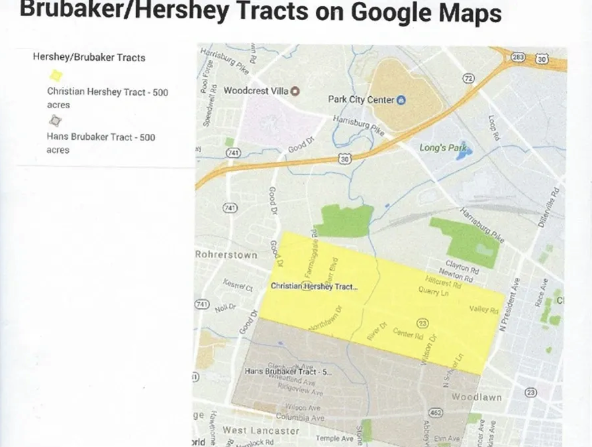
Christian Hershey, ancestor of the famous chocolate maker, Milton, was the first member of the Hershey family to come to America and was the owner of the portion of land that now involves Conestoga House & Gardens (on the map in yellow). The Hershey family owned the property for 4 generations and is credited with being one of the finest farms in South-Central Pennsylvania. The central portion of the house was built by Benjamin Hershey the 3rd, between 1812 and 1815. It was constructed either on a previous structure’s foundation or as a new one.
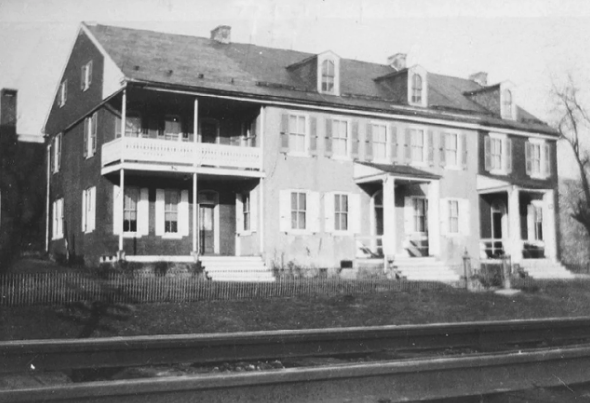
The center, as seen above, was one of three houses shown in this 1927 photo. This was taken at the time that Colonel James Hale Steinman and his lovely wife Louise Tinsley Steinman purchased their 13-acre plot of land. There were a couple of owners in between the Hershey family and the Steinman family, but I will focus on these two prominent ones as they impacted the property the most.
The 1812-1815 center structure, as reported above, was probably built on a previous foundation. We have no information about or record of the previous foundation/structure, but there are two artifacts still preserved at Conestoga House today, which give us a hint of information about one aspect of it. It was common to have what was considered all the rage in heating homes during this time and there is evidence that the house had one… a five-plate stove (example pictured below).
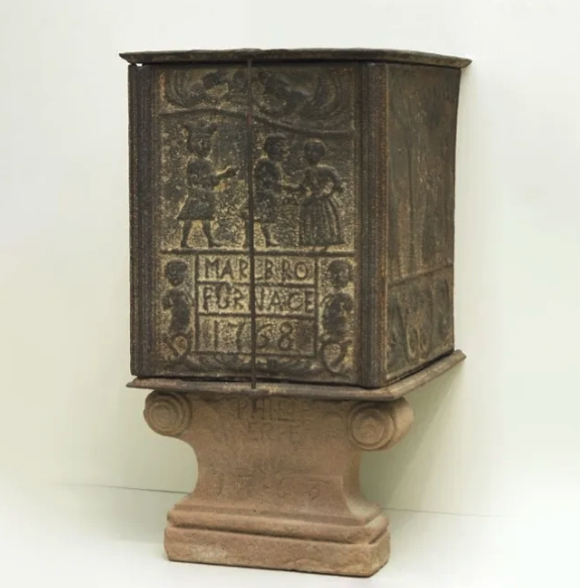
Notice the five individual plates, top, bottom, two sides and one face plate. It was common for these side and face plates to be decorated with Biblical imagery and scripture. The top and bottom plates were just plain.
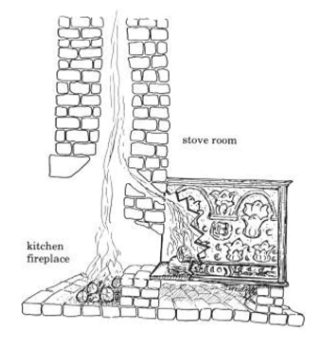
Fireplaces were usually on the outer wall of kitchens. This new type of stove was mounted on what was a fireplace inside wall of the kitchen, adjoining the next room. It was centralized heating, meaning in the center of the house - not the exterior wall. It was also called a ‘jamb stove’. Hot coals from the kitchen fireplace were shoveled into the stove to help heat that next room. You could also bake cakes, bread, muffins, and other foods that needed to be slowly baked or kept hot for meals. Benjamin Franklin improved on this type of oven with his Franklin stoves that he manufactured in early America. Notice the stone base; It was carved or scrolled with acanthus leaves as a decoration. Legs were not made in this early version of oven. The Franklin Stoves would later use wrought-iron legs that made the stoves easier to set up and increased stability.
I am giving you detailed information about this because there are two pieces of a stove like this here at Conestoga House. We have a right plate and the stone base being used here for other purposes. Below is an image of the base stone.
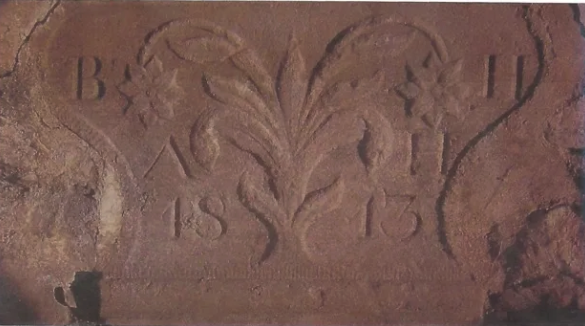
You will notice that there are the initials of “B” and “H” and date 1813.
Stone base, c. 1765, carved by an unknown stone cutter working in Lancaster County, Pennsylvania. This stone base originally supported a five-plate stove, that probably stood in the c. 1765 stone house of Bishop Benjamin Hershey (c. 1730-1812) and his wife Magdalena (Roadt) Hershey of Lancaster Township, Lancaster County. The open end of a stove was built into the wall of the central fireplace where it could be fueled from the kitchen or hallway. The stove was typically supported by a simple masonry support. Shaped and carved bases, such as this example, are rarely encountered in Pennsylvania. They were, however, directly inspired by Palatine prototypes. The date and initials on this stone leg were added by Benjamin Hershey, the son of Benjamin Hershey (c. 1730-1812). The younger Hershey remodeled the farmhouse, added his initials and the date, 1813, to the old stove support, and then installed it as a datestone. Sandstone, 12 " x 16.5 ", courtesy of The Conestoga House. Photograph by Lee F. Stoltzfus.
When the base was carved, it would not have included the initials or date because, at the time, it was a simple support stone for the stove. When the 1812-1815 house was built the 5-plate stove was dismantled, but the base was used as a date stone on the new mansion. The plates were kept, but only one plate was used by the Steinman family as a hearth plate in the back of the fireplace in the present Lime Kiln. The stone base was removed by the Steinman family when they renovated the present house in the 1930’s. They used the stone as a decoration in the Back Terrace Pond under the stone plinth that functions as a waterfall aspect to the pond.
The decorated 5-plate stove was manufactured in the Reading area at a forge that is now called Hopewell, but that had been called Christine (Kristine) Furnace back in the 18th century. This plate is documented in their archives. The decoration was Pennsylvania Dutch, meaning the words were in that language, as almost everyone spoke a German dialect in this area at the time - especially the farmers, who were Mennonite. The images included the date, 1748, sheaves of corn and wheat, a wheel of life, a hand water pump, the initials of the iron master, Warren Barnes, and the initials of the furnace maker, K.F., spelled phonetically for Kristine Furnace. There is a Pennsylvania Dutch saying above the date, which in English is translated to “God’s well has water a plenty”.
We also know the house was built during the 1812-1815 period because there were Lancaster County Tax records indicating that a tax was levied against the property beginning in 1812. Now, there weren’t any property taxes, sales taxes, school taxes or personal taxes in existence yet. So, what tax could this be for? Apparently, there were taxes that could be levied against a property if you were installing flat glass windowpanes. These windowpanes had to be imported from Europe because they were not being made in America at that time. They were expensive to purchase and ship, so it was sort of a Luxury Tax on something that only affluent people could afford. This would mean that the Hershey family were very successful in farming and other related areas of commerce. I will elaborate on this later.
I don’t fully understand what they used to put in window frames other than possibly using glass used in making bottles which was green in color and not clear at all. They would blow the bottle and then cut the top and bottom off and cut the cylinder in half and flatten it out while still hot. It was very crude but could be used in small windows. If you didn’t use glass, you would just use wood or shutters and heavy cloth(burlap) as drapes or curtains.
The additions to that 1812-1815 house were most likely added around 1870 for the eastern end and 1880 for the western smaller end. The house at some point during this later period was used as an inn for travelers on their way to Harrisburg and points West.
I think we can stop here for now, which would be right before the Steinman family purchased the property in 1927. I hope that some of this was of some interest to you. If you have any information that could shed more light on explaining this time period, that would be most welcome!
As always, if you have any related questions that you’d like to ask, please submit them to conestoga@ecklindevelopment.com.
Until next time,
Larry