

The Evolution of Conestoga House Continued
We will now continue with the history of Conestoga House. The last blog left off right before the Steinman's purchased the property in 1927.
The Steinman family was interested in this land because of its location and size. In 1926, the family contacted architectural firm Mellor, Meig & Howe from the Philadelphia area to draw up a plan and develop a strategy to achieve what they envisioned for the property. They wanted to build a large European style estate that would befit their lifestyle, being up and coming business and social leaders. I have a drawing of what it would have looked like in my records. They wanted the main house to be sitting up on the upper level of the layout with a long driveway, ascending from Marietta Avenue. Most European estates have their buildings set back from a main road for privacy reasons. The design called for a fork shaped construction with a family wing, a guest wing, and servants’ rooms. Here is what it looked like.
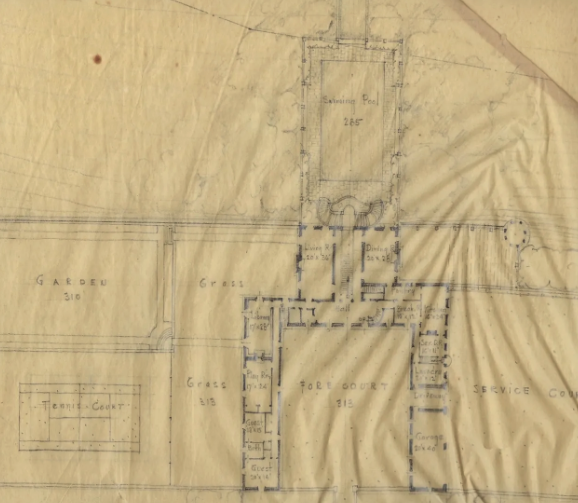
It’s a little hard to see but you can make out the main idea and design. It would have been a fabulous house. I am not sure why they declined to go with this plan, but it would have been a beautiful home to live in. The buildings that were on site were already old, from the 1800’s, so the choice I believed boiled down to economics.
I will go through some of the history of this part again, so please refer to my earlier blog for additional information.
I will state, again, that the central portion was built between 1812-1815. We know this because there is evidence downtown in the Lancaster County Courthouse. It showed a record of taxes levied against the property. Now, what sort of taxes could that be? There were no property, school, sales, or income taxes yet in existence. This was not very long after the Revolutionary War for Independence. We all know that taxes were a big issue.
Apparently, Benjamin Hershey III decided to have flat glass windowpanes installed in the house. Flat glass was not produced in the new nation and had to be shipped from Europe. That was at considerable expense, so it was most likely a luxury tax applied to the property. You might ask, “What did they use for windows before this”? Maybe you should do a little investigation on this interesting question and see what you come up with.
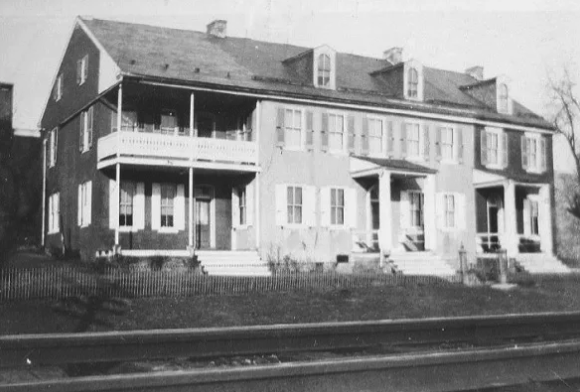
In any case, the Steinman’s decided to transform the three houses into one. The eastern portion was believed to have been constructed around the 1870 era. The western end, around 1880. Notice the trolley tracks in the foreground. There used to be a single lane road between the house and the tracks. A model T Ford car would travel down the road once every couple of hours.
Mellor, Meigs & Howe were retained to do the landscaping and construction of the garage and stable complex, the Lord & Burnham glass greenhouse, and the pool house, as well as the preservation of the lime kiln and various outbuildings. Terracing the gardens and transforming the simple courtyard to be European in style with pillars and walls was also implemented in the final product.
The main house was the first phase of transformation with Frank Everts, local architect, and Charles Demuth being brought in to help. Work on the outer portion of the grounds did not commence until 1937. Everything was completed by 1950. Essentially, nothing has changed since that time.
The last construction to be completed was the Orangery. This is an early form of greenhouse developed in Europe after Marco Polo and the other explorers had brought back citrus (oranges, lemons, limes, and grapefruit) from the Far East, China, India, and Southeast Asia. They are not hardy, so structures had to be built to keep the plants through the winter. Walter Macomber, who was a consulting architect from Colonial Williamsburg and Mount Vernon, was retained to design the Orangery. It was finished in 1950.
The Steinmans maintained the estate at the highest level, and they enjoyed having many events and parties up until the passing of Colonel James Hale Steinman in 1962. He was a LT. Colonel during WWI. Everyone wanted an invite to the Conestoga House during those years of entertainment. There were big bands like Benny Goodman style musicians constantly in appearance. Steel drum bands for that tropical feel would frequent the estate throughout the summer days.
After his death, it became more subdued and less used for parties. Louise Steinman lived here until her death in 1980. She loved Conestoga House and enjoyed being there during her last remaining years. Remarried in 1972, she and her husband enjoyed New Years Eve parties here at Conestoga House.
After her death, the Steinman daughters enacted their fathers will which simply stated that the grounds should be prepared for summer garden tours and education in Horticulture. That is a story for another blog.
As always, if you have any related questions that you’d like to ask, please submit them to conestoga@ecklindevelopment.com.
Until next time,
Larry